DRM Statement, January 29, 2026
We recognize that this storm has created serious challenges, and that extremely cold temperatures and repeated freeze–thaw cycles make snow and ice removal more difficult. We appreciate the actions Baltimore City and Maryland are taking and their efforts to communicate with residents. At the same time, more must be done to ensure that people with disabilities are not left without access to transportation, medical care, work and their communities.
When sidewalks, curb cuts, and bus stop boarding areas are not fully cleared of snow and ice, people with disabilities can be effectively cut off from public transit and daily life, even after roads become passable. For wheelchair users, people who use walkers or canes, and many other people with disabilities, a single blocked curb ramp can make an entire trip impossible. In situations like these, we routinely hear that people miss medical appointments, cannot get to work, or are forced to remain at home days after a storm because the pedestrian network is only partially cleared. When sidewalks are impassable, people are often forced into the street to get around snowbanks or ice, creating serious and predictable safety risks.
These impacts are compounded during prolonged cold snaps like the one Maryland is experiencing now, where hardened snow and refreezing turn untreated areas into sheets of ice. In these conditions, accessibility barriers are not just inconvenient; they are dangerous and exclusionary.
These issues are also not new. Baltimore has a history of inaccessible sidewalks and curb ramps. The City is operating under the Goodlaxson1 partial consent decree. Under the ADA and the Goodlaxson consent decree, Baltimore has an obligation not only to build accessible sidewalks and curb ramps, but to maintain them in a condition that people with disabilities can actually use. The decree also mandates an annual public initiative to educate the public on the need for timely removal of snow and other debris from curb ramps and pedestrian walkways that provide access to bus stops and public transportation stations.
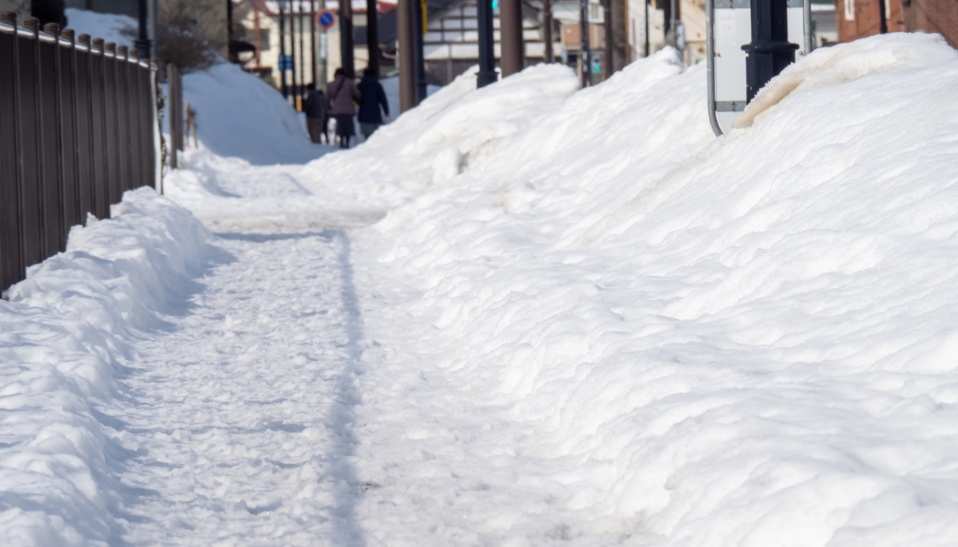
Maintenance also means clearing sidewalks to a fully usable path width, not just a narrow trench. After snowstorms, sidewalks are often cleared only to a narrow, shovel-width path. While well-intentioned, this does not accommodate wheelchair users, people with walkers or other mobility devices, or others who need space and stability to move safely. For many, including people with visual disabilities, these narrow and uneven paths can be disorienting and hazardous. A path that narrow is functionally unusable and can be just as exclusionary as no clearing at all.
In Baltimore City, residential and commercial property owners are legally required to clear snow and ice from sidewalks within three hours after a snowfall ends, or by 11:00 a.m. if snowfall stops between 3:00 p.m. and 6:00 a.m. While enforcement may vary during extreme conditions, these requirements exist because sidewalks are part of the public pedestrian network and must remain accessible to everyone. The Baltimore Snow Corps pilot program reflects an important recognition that older adults, people with disabilities, and others may need assistance clearing sidewalks.
These conditions also directly affect people who rely on paratransit services, who must be able to safely access the vehicle. When sidewalks are icy, narrowed, or blocked, people may be unable to reach the pickup point, board the vehicle safely, or navigate from the drop-off location to their destination. The result is that people may lose access to essential services, not necessarily because the service is unavailable, but because the surrounding pedestrian environment makes it unusable.
For many riders with disabilities, buses running does not mean transit is usable if sidewalks, curb ramps, and bus stops remain blocked or unsafe. Without clear and accessible paths to reach buses, people remain effectively cut off from transportation and community access even as service resumes.
If roads reopen but sidewalks, curb ramps, bus stops, and pedestrian routes remain blocked or constricted, transportation and community access are “open” in name only for people with disabilities. True recovery from a storm requires clearing the full accessible travel path so that people with disabilities can safely move through the city and maintain access to care, work, and community life on the same timeline as everyone else.
Gabriel Rubinstein
Managing Attorney
Disability Rights Maryland