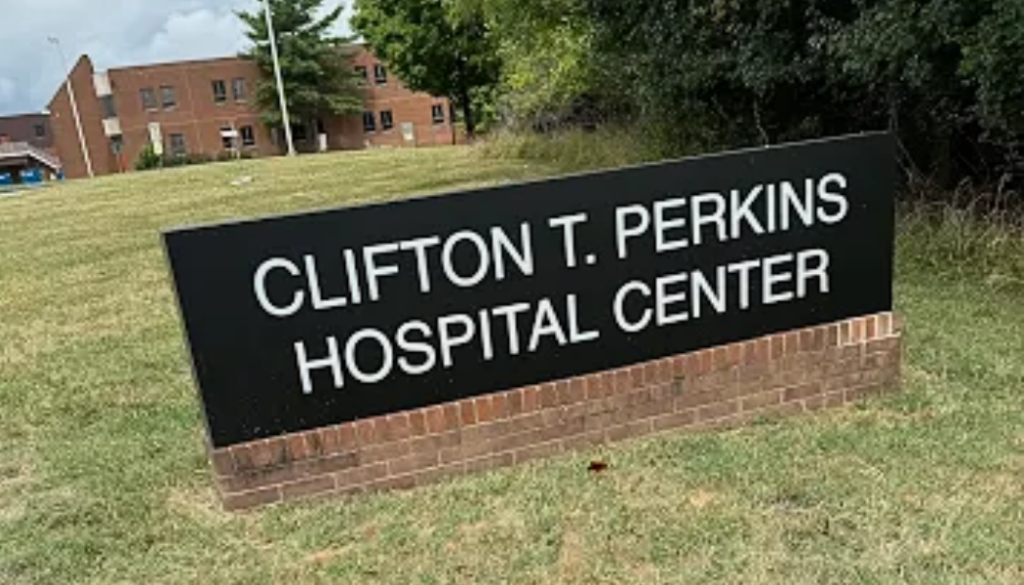
Treatment Not Trauma: Urgent Action Required to Protect Patients at the Clifton T. Perkins Hospital Center
Below you will find some sections of the report. Click the button for the full report.
Disability Rights Maryland (DRM) conducted a two-year investigation into one of Maryland’s forensic psychiatric hospitals, the Clifton T. Perkins Hospital Center (CTPHC). DRM launched the investigation as a result of the receipt of numerous complaints of abuse and neglect, including alleged violations of the following basic rights:
- The right to be free from sexual assault and sexual harassment;[1]
- The right to be free from restraint and seclusion, unless used in an emergency when one’s behavior poses a serious threat of violence or injury to self or others;[2]
- The right to individualized treatment;[3] and
- The right to receive care that restricts one’s liberty and freedom only “…to the extent necessary and consistent with the individual’s treatment needs…”[4]
DRM’s investigation into these concerns included patient surveys, interviews with staff members at all levels of hospital operation, and an analysis of relevant records.
Overall, DRM finds a need for the State to increase transparency and strengthen accountability by improving oversight systems. In light of Governor Moore’s mission to ensure that “No One is Left Behind,” DRM urges immediate action to protect the hundreds of people currently left behind at CTPHC. [5]
Key Findings
Finding #1: Lack of Appropriate Medical Care.
The most critical finding from DRM’s investigation is the inadequate access to medical care at CTPHC, which has resulted in adverse health outcomes and possibly contributed to patient deaths. To illustrate this finding, this report includes the detailed investigation findings of two women and one man who died (“Marissa”, “Latasha”, and “Charlie”) and one man (“James”) who suffered serious medical complications following delayed medical care. See the appendices to this report for detailed investigation findings for each case.
The poor medical care these patients received is not isolated or unique; these cases are representative of a systemic failure to provide essential medical care to patients. The four highlighted examples illustrate delays and denials in basic medical care, specialist care, mental health care, and emergency medical care that meet the protection and advocacy statutory criteria for “neglect.”
Neglect in mental health facilities is defined as “…a negligent act or omission by an individual responsible for providing services… which caused or may have caused injury or death to a[n] individual… or which placed a[n] individual… at risk of injury or death, and includes an act or omission such as the failure to establish or carry out an appropriate individual program plan or treatment plan…, the failure to provide adequate nutrition, clothing, or health care…, or the failure to provide a safe environment.., including the failure to maintain adequate numbers of appropriately trained staff.”[26]
Marissa's Story
“Marissa” was a 40-year-old African American woman who died in November 2023, just three months after her admission to CTPHC. Just days before she died, her social worker noted in her medical record that she was “stable” and “preparing for discharge.”[27] Unfortunately, she never had the opportunity to return to the community.
DRM’s investigation found multiple concerns with the medical care Marissa received:
- CTPHC failed to provide care for Marissa’s chronic health conditions, and she was not seen by relevant specialists.
- CTPHC failed to provide adequate staffing to ensure patient safety.
- CTPHC failed to respond appropriately to her emergent medical needs during the days preceding her untimely death. Over the four days preceding her death her health continuously deteriorated, yet she was not taken to an emergency department for assessment and treatment. The day before she died staff called 911 but then cancelled the ambulance and Marissa remained at CTPHC.
- On the day she died, CTPHC medical staff failed to provide even basic life support, including CPR.
- CTPHC did not report Marissa’s death to DRM or OHCQ as required by statute.
- Marissa’s autopsy report states that she died due to “acute intoxication” of chlorpromazine, diphenhydramine, and sertraline. Each of these medications had been prescribed by CTPHC physicians.
The death investigation completed by OHCQ found that many CTPHC staff did not have current CPR certifications, and that the overhead emergency paging system was not operational. OHCQ’s report did not cite many additional problems identified by DRM with respect to the medical care provided to Marissa by CTPHC.
CTPHC’s failure to provide adequate medical care for Marissa constituted neglect as defined by 42 U.S.C. §10802(5) and 45 C.F.R. §1326.19.
Finding #2: Lack of Appropriate Behavioral Health Care at CTPHC.
In addition to deficits in the provision of somatic medical care (Finding #1), DRM found that CTPHC patients do not consistently receive needed behavioral health treatment. CTPHC should provide patients with mental health treatment that provides “a realistic opportunity to be cured or improve the mental condition for which they were confined.”[40]
The psychiatric hospitalization of an individual does not in and of itself constitute treatment for their behavioral health needs. As the authors of “Inpatient Psychiatric Care in the 21st Century: The Need for Reform” explain, a “focus on ensuring only safety leads to an overemphasis on the biological aspects of care (generally psychopharmacologic) to reduce aggressive behavior and leaves far too little time to address the psychosocial aspects critical to understanding and intervening in the larger context and changing the course of illness.”[41]
Patients at CTPHC deserve access to a full array of treatment options, not just medication. Without meaningful therapies, activities, and personal engagement, CTPHC risks becoming no more than a holding area, or worse – a prison for people who have not been sentenced. The hospital’s mission and vision include providing “recovery-based, trauma-informed care…within a … therapeutic environment”[42]. That mission and vision necessitate looking at the patient as a whole person and offering treatment to meet their medical and psychiatric needs.
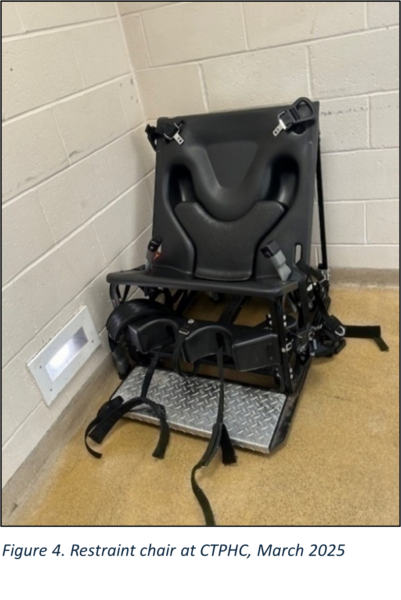
Finding #3: Unlawful Use of Seclusion and Restraint at CTPHC.
Among the more serious complaints raised by patients at CTPHC is the violation of one’s right to be free from restraint and seclusion of any form when used as a means of coercion, discipline, convenience, or retaliation.[64] Restraint or seclusion may only be imposed to ensure the immediate physical safety of the patient, a staff member, or others and must be discontinued at the earliest possible time.[65] A physician’s order for restraint or seclusion of an adult may not exceed four hours. In addition, before using restraint or seclusion, staff must first consider other less restrictive strategies.[66]
Finding #4: Safety Concerns at CTPHC.
During interviews with DRM staff, CTPHC patients and staff raised concerns about physical and psychological safety in the hospital. For example, some interviewees expressed concern about assaults by other patients or that they might face retaliation or intimidation for speaking up or raising concerns. In fact, concerns about safety at CTPHC stretch back decades. In 2012, after three patients were killed in the facility, the State responded by commissioning an independent evaluation and report by Drs. Appelbaum and Dvoskin.[88] Unfortunately, many of the recommendations in their report have still not been implemented[89] and significant safety concerns persist.
Finding #5: Lack of Transparency, Accountability, and Oversight.
Many of the problems identified in this report have persisted, at least in part, because of the lack of meaningful oversight and accountability on the part of CTPHC leadership, OHCQ and MDH.
OHCQ has made repeated noncompliance findings but has been unwilling or unable to ensure that the violations are remediated. It appears that MDH has only stepped in to make leadership changes and provide additional resources when called to task by the Maryland General Assembly or by news articles over the years that focused attention on violence and dire conditions in the hospital. Of concern is that MDH has not made the NASMHPD report public. Particularly after the recent Washington Post articles about conditions at the hospital, release of the report along with the steps MDH is taking to implement the report’s recommendations would be a welcome step towards rebuilding public trust in the Department’s ability to meet the needs of patients at CTPHC.
Additionally, CTPHC leadership itself has not held staff accountable for their actions or failures to act when patient health and safety have been endangered, as DRM found in its investigation of the deaths of Marissa, Latasha and Charlie, and the lack of appropriate medical care for James. Further, CTPHC’s lack of transparency in reporting resulted in DRM learning of Latasha’s death from another patient, rather than through hospital leadership.
Conclusion
DRM initiated comprehensive monitoring and investigation culminating with this report because of the volume of patients reporting concerns about inadequate conditions, the care they were receiving, and other violations of their rights. The project spanned three hospital CEOs, and DRM is pleased to have established a respectful and professional relationship with the current CEO. DRM also appreciates that Dr. Jones has made robust efforts in a short period of time to address a number of the issues identified in this report. Much work remains to be done, but DRM is hopeful that CTPHC administrators will view the recommendations in this report with an eye toward continuing to move CTPHC forward “to re-establish Clifton T. Perkins as a nationally premier institution, renowned for safety, excellence in patient care, clinical training, and research for Maryland’s forensic psychiatric patients.”[129] DRM looks forward to continuing to support CTPHC in its efforts to make the hospital the therapeutic environment it is intended to be.
DRM recognizes that some of the issues faced by CTPHC cannot be solved by CTPHC alone. Our recommendations to MDH are aimed at strengthening accountability and oversight and ensuring that the needs of patients and staff are not overlooked as budget and administrative decisions are made.
Access the Full Report
Loading PDF...
Error loading PDF. Please check the URL or file.
[1] Md. Code Ann., Health-General §10-705; 42 C.F.R. §482.13
[2] Md. Code Ann., Health-General §10-701; 42 C.F.R. §482.13.
[3] Md. Code Ann., Health-General §10-701.
[4] Id.
[5] https://dbm.maryland.gov/Documents/MFR_documents/2026-MFR-Annual-Performance-Report.pdf, pg.2
[26] 42 U.S.C. §10802(5); see 45 C.F.R. §1326.19
[27] Social work monthly note for October 2023 in Marissa’s medical record.
[40] Sharp v. Weston, 233 F.3d 1166, 1172 (9th Cir. 2000) (citing Ohlinger v. Watson, 652 F.2d 775, 779 (9th Cir. 1980)).
[41] Ira D. Glick, Steven S. Sharfstein & Harold I. Schwartz, Inpatient Psychiatric Care in the 21st Century: The Need for Reform, 62 Psychiatric Services, 206-09 (2011), p. 207. https://psychiatryonline.org/doi/abs/10.1176/ps.62.2.pss6202_0206.
[42] https://health.maryland.gov/perkins/Pages/hOME.aspx (emphasis added)
[64] COMAR 10.21.12.03; COMAR 10.21.13.03; 42 C.F.R. §482.13.
[65] COMAR 10.21.12.03; COMAR 10.21.13.03; Md. Code Ann., Health-General §10-701.
[66] Joint Commission Standards PC.03.05.01 and RI 01.06.01 https://publicstandards.tools.jointcommission.org/2.DOMESTIC , and see https://digitalassets.jointcommission.org/api/public/content/1976b0291a284a8fa7a7b47d26808b5a?v=73722715
[88] Appelbaum, K.L. and Dvoskin, J.A. (2012, January 10). Consultation report on the Clifton T. Perkins Hospital Center.
[89] https://www.baltimoresun.com/2012/01/12/experts-offer-safety-measures-at-perkins-hospital-2/
[129] https://mgaleg.maryland.gov/meeting_material/2025/fps%20-%20134061478837778215%20-%20Meeting%20Materials%2010-29-25.pdf
Navigation
About DRM

Disability Rights Maryland (DRM) is a private, nonprofit 501(c)(3) organization advocating to improve the lives of Marylanders with disabilities. Combined Federal Campaign #76352; United Way/Maryland Charities Campaign #5178.
The information on this website is not offered as legal advice and should not be used as a substitute for seeking professional legal advice. No information on this website creates an attorney-client relationship with you.
Contact
Phone: 410-727-6352
Toll Free: 1-800-233-7201
TTY: 410-235-5387
Fax: 410-727-6389
Mail: Disability Rights Maryland
1500 Union Ave, Ste. 2000
Baltimore, MD 21211
© Copyright 2020 – Disability Rights Maryland. All Rights Reserved.