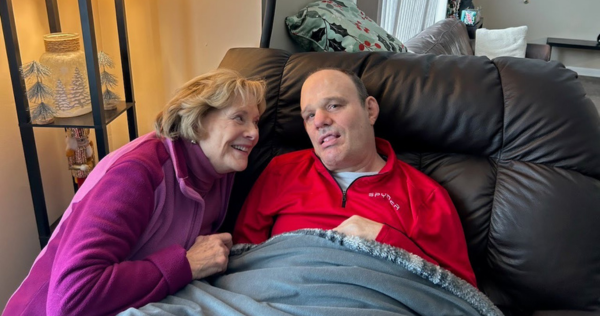
When Linda talks about her son Troy, her face lights up. “He’s my inspiration,” she says. Troy is almost 57 and has lived his entire life with tuberous sclerosis, a rare genetic disorder that causes tumors to grow in the brain and other organs. It has meant years of seizures, developmental delays, and constant medical care — but it has also meant a lifetime filled with joy, humor, and resilience.
Troy grew up surrounded by love. As a baby, he started having seizures at six months old. Doctors didn’t know what was wrong at first. The condition wasn’t widely recognized in the U.S. at the time. Still, Linda pushed for answers. She worked full-time, raised her son, finished her degree at Towson University, and completed a master’s program at Johns Hopkins — all while becoming Troy’s fiercest advocate.
“I knew I needed to learn everything I could,” she says. “Nobody gives you a manual when your child is born.”
Eventually, specialists at Kennedy Krieger and Johns Hopkins finally diagnosed Troy. The seizures, the tumors, the developmental delays — it all made sense at last. And from that moment on, Linda built her life around making sure Troy got the support he needed to live safely and with dignity.
For decades, Troy had funding for one-on-one community support — a service that provided trained staff to help him move safely through daily life. With multiple seizure types and mobility challenges, Troy cannot go out alone. He needs someone with him when he walks, travels, or even gets into a car.
“It’s common sense,” Linda says. “He’s medically fragile. He needs help.”
But in December of last year, everything changed.
Linda got a letter saying the state planned to cut Troy’s one-on-one services — support he had received for nearly a decade. The explanation was vague. The reasons didn’t make sense. And no one could tell her exactly what was “wrong” with his paperwork.
“It felt like trying to play a game when you don’t know the rules,” she says.
The nursing plan? They said it wasn’t “adequate.”
The personal plan? They said it wasn’t “current enough.”
When Linda pressed for details, she got none.
Her heart dropped.
She knew what losing that funding would mean: fewer outings, more isolation, and far more risk. Troy’s health had already declined. He now used a G-tube for feeding and had trouble walking on his own. Removing support now wasn’t just confusing — it was dangerous.
“I thought, ‘You’re taking away the very thing that keeps him safe?’” she remembers. “I couldn’t accept that.”
So, Linda did what she’s always done. She fought. Hard.
She gathered letters from doctors, including the state’s only adult tuberous sclerosis specialist. She pushed for updated assessments, collected months of documentation, organized support from his provider agency, and searched for someone — anyone — who could help her navigate the confusing system. A system she had worked in for over 4 decades in various capacities.
That’s when she called Disability Rights Maryland.
“When the phone rang and someone said, ‘We got your message, please be patient,’ it meant everything to me,” she says. “Just to be heard.”
From there, Linda connected with an attorney who took her concerns seriously, explained her options, and guided her through the appeal process. For the first time in months, she didn’t feel like she was fighting alone.
And she was determined to do more than win for just her son.
“This isn’t only about Troy,” she said. “This is about every family who gets a letter they don’t understand. Every parent who’s older. Every person who doesn’t have someone to fight for them.”
And for the next seven months, that’s what she did — with a team behind her and her son beside her.
When Families Fight Alone — and Why No One Should Have To
By the time the spring arrived, Linda had spent months chasing paperwork, calling agencies, collecting medical letters, and pushing through a process that felt confusing at every turn. And she knew she wasn’t the only one.
Across Maryland, families of people with disabilities were quietly losing services — sometimes without clear explanations, sometimes without the tools to fight back, and sometimes without anyone in their corner.
“I kept thinking about parents who are in their 70s, caring for adult children in their 50s,” she says. “What happens to them when the state takes away funding? Who helps them when they don’t even know where to start?”
Fear and confusion are powerful barriers. Many people give up before they even begin.
“Fear keeps you stuck in the mud,” Linda says. “But you can’t let it win. You can’t do it alone either.”
That’s why she kept pushing.
With guidance from a DRM attorney, Sandy Balan, she learned about a process she didn’t even know existed: a case resolution conference. It was a chance to meet directly with the state and present updated information before going to a full hearing.
And Troy could be part of it.
Linda arranged for the meeting to take place at Troy’s home. His longtime house manager set up the video screen. Staff members joined. And when the state representatives logged in, they didn’t just see paperwork — they saw Troy, a strategic decision by Linda.
They saw him walk carefully with a gait belt.
They saw his fatigue.
They saw the reality of his health after a year of decline.
“They said, ‘We didn’t know things had changed this much,’” Linda remembers.
For the first time, she felt the system pause long enough to truly see her son.
And that changed everything.
Within weeks, the state reinstated Troy’s one-on-one community support. The funding he had relied on for nearly a decade would return in December.
“I knew we won right there,” Linda says. “Not just for us — but for everyone who needed somebody to keep fighting.”
But the victory also underscored a deeper problem.
Many families don’t know their rights. Many don’t know where to ask questions. And too many feel defeated before they begin.
The letters are confusing.
The rules are unclear.
The deadlines are tight.
And the stakes are enormous.
“People are losing services for reasons they don’t even understand,” Linda says. “It shouldn’t take a master’s degree, decades of experience, and a full team of professionals just to keep someone safe.”
That is exactly why Disability Rights Maryland matters.
DRM completed the team she needed: the attorney who knew the law, the guidance to gather evidence, and the reassurance that she didn’t have to navigate the system alone.
“You were the wind beneath my wings,” she says. “I slept at night because I knew you were behind me.”
Now, Linda wants other Maryland families to know that help exists — and they deserve to use it.
Her advice is simple and powerful:
- Don’t give up before you start.
- Build a team from people who already care about your loved one.
- Ask questions until you get clear answers.
- Lean on professionals and friends who support you.
- And don’t let fear make you believe you’re alone.
Because no family should have to fight this hard for basic safety. No one should lose services because they didn’t understand a form. And no one should feel abandoned in a system that is supposed to protect them.
Troy is doing better now. His nutrition is stable. His care team understands his needs. And thanks to his reinstated funding, he can continue to go outside with the support he needs to stay safe.
“He’s resilient,” Linda says. “He inspires me every day.”
Her hope is that Maryland listens — not just to her, but to every family fighting quietly in the background.
“Why take away support from people who need it most?” she asks. “It’s wrong. And it’s happening more than people realize.”
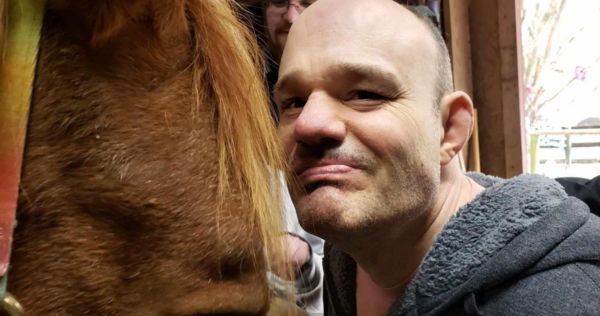
Linda and Troy’s story makes one thing clear:
Families shouldn’t have to fight these battles alone. And because of supporters like you, they don’t have to.