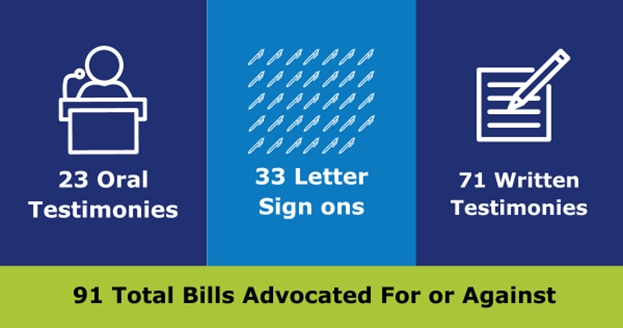
The legislative session was full of successes and challenges. DRM worked with partner organizations, individual allies and legislators to advocate for bills that advance disability rights and against bills that exclude people with disabilities in Maryland. This year, DRM took a position on a total of 91 bills. We submitted 71 written testimonies, orally testified on the impact of 23 bills and joined other organizations in signing 33 letters of support or opposition. Below are the highlights from this year’s session.
MOBILITYLINK PARATRANSIT SERVICE IMPROVEMENTS STUDY (SB0891/HB1199)
This study establishes an objective review of the Maryland Transportation Administration’s MobilityLink. The Maryland Transportation Institute (MTI), an independent third party, will conduct the study to determine the best methods to deliver MobilityLink service. MTI will look holistically at MobilityLink—including its service delivery model, customer service, reliability, performance, and workforce—and compare it with other paratransit providers nationwide. MTI will provide policymakers with concrete recommendations to improve service for Marylanders with disabilities. “MobilityLink riders rely on the service to access their community and unfortunately often experience poor service – like late pick-ups and drop-offs, long trips, and lengthy hold times for customer service calls. DRM is hopeful that MTI’s tangible recommendations will propel Maryland to enact sweeping paratransit reform to give Marylanders with disabilities the safe and reliable public transportation they deserve.” says DRM attorney, Daria Pugh.
NEW UNIT TO PROTECT PEOPLE IN STATE CORRECTIONAL FACILITIES (SB0134/HB0297)
“DRM’s investigations and monitoring of Maryland prisons over a number of years has demonstrated that people with disabilities are often subject to dangerous, violent, and unhealthy conditions. The General Assembly’s creation of an independent, impartial correctional ombudsman for Maryland is a hopeful step forward .” says DRM’s Litigation Counsel, Luciene Parsley. After 2 years of advocacy, Maryland will establish the Correctional Ombudsman Unit to investigate complaints and issue findings and recommendations. Increased oversight, transparency and accountability is important to address systemic issues and rights violations in Maryland’s correctional facilities. Additionally, the new unit provides a way to address rights violations that fall within the gaps of current complaint issue areas, like complaints against contractors who provide medical and mental health services for the Department of Public Safety and Correctional Services (DPSCS). The unit will report annually to the General Assembly, including information about systemic issues, rights violations and how DPSCS responds to the Ombudsman’s recommendations.
FUND FOR FAMILIES TO ACCESS SPECIAL EDUCATION ATTORNEYS, ADVOCATES AND CONSULTANTS (SB0797/HB0903)
This bill establishes a program to help families with limited financial resources access lawyers, advocates and education consultants for a variety of special education matters. Currently, DRM maintains a pro bono referral program for families with very limited means, but this will enable a broader range of families to access attorneys and, for the first time, to obtain services from advocates or consultants at no cost to them. The attorneys, advocates and consultants will be paid through the program, which will be administered by the Maryland Volunteer Lawyers Service (MVLS). DRM attorney Leslie Seid Margolis and the Education Advocacy Coalition crafted the bill that will soon help thousands of Maryland students. “I look at all the education intakes that come in and it’s hard to put into words what it feels like to turn families away, knowing how limited their options have been; this program will be so helpful in expanding the resources available to families.” This is important because families who have advocacy assistance are better equipped to secure appropriate services for their children and resolve education issues. The passing of this legislation brings us closer to ensuring all students have what they need to be successful in school.
Last year, Maryland passed a law that lets families get money back for expert costs in addition to attorneys’ fees if they win a case against a school system. This new program is different because it enables families to access legal support at all stages of the special education process, not just when they are facing a due process hearing; the program emphasizes assistance for families for Individualized Education Program (IEP) meetings and informal dispute resolution.
SELF-DIRECTED MENTAL HEALTH SERVICES PILOT PROGRAM (SB0988)
DRM introduced a bill that would create a self-directed mental health care pilot program for people with disabilities. Bills such as this one often take several years to pass, and DRM will continue to advocate for this program next year. Studies show that when people can manage their own care, they do better in their communities and are less likely to live in institutions. Most importantly, many people with disabilities prefer this kind of care. Right now, some people with serious needs must settle for inadequate help, join programs that might not fit them well, or go without help entirely. This new program would allow people to make a plan that fits their needs instead of making their needs fit into the current service system. Self-directed mental health care is already working in 6 states and is a good step toward fair treatment for mental health issues.
ASSISTED OUTPATIENT TREATMENT (SB0453/HB0576)
DRM opposed the expansion of involuntary civil commitment laws, including the creation of an Involuntary Outpatient Civil Commitment program, termed “Assisted Outpatient Treatment” (AOT). AOT had strong support from the current administration and passed in both the House and Senate. Testimony in favor of AOT revealed many fears and stereotypes about people with mental health disabilities’ capacity to make decisions about their minds and bodies. DRM believes people with mental health disabilities should be provided with any accommodations and supports necessary to make and communicate health care decisions, and that individuals have the right to receive care in the most integrated setting available. AOT meets none of these criteria. DRM is concerned that AOT risks jeopardizing efforts to create an innovative, behavioral health system in Maryland – one that is truly focused on supporting the voices and choices of people with mental health disabilities to receive the support they need to be included in our communities.
Thank you!
DRM would like to thank our donors whose support enabled us to advocate for people with disabilities throughout the 2024 legislative session.
If you are passionate about creating a more equitable Maryland and able to give, please consider making a generous contribution to support our work. We rely exclusively on gifts from individuals and general operating grants to support this work.
SUPPORT DRM TODAY!