UPDATE: Thank you for participating! Please share how we can make it better next year!
Week Without Driving 2026: Transportation Bingo
October 1-8
Disability Rights Maryland (DRM) is participating in Week Without Driving, a national campaign taking place October 1-8, 2026. The initiative challenges drivers to go without driving for one week to better understand the barriers faced by people who cannot or do not drive.
Whether due to age, ability, or financial circumstances, nearly a third of Americans cannot drive. Transportation access remains one of the most significant barriers to employment, healthcare, and community participation for Marylanders with disabilities. Week Without Driving is a chance to see the world differently.
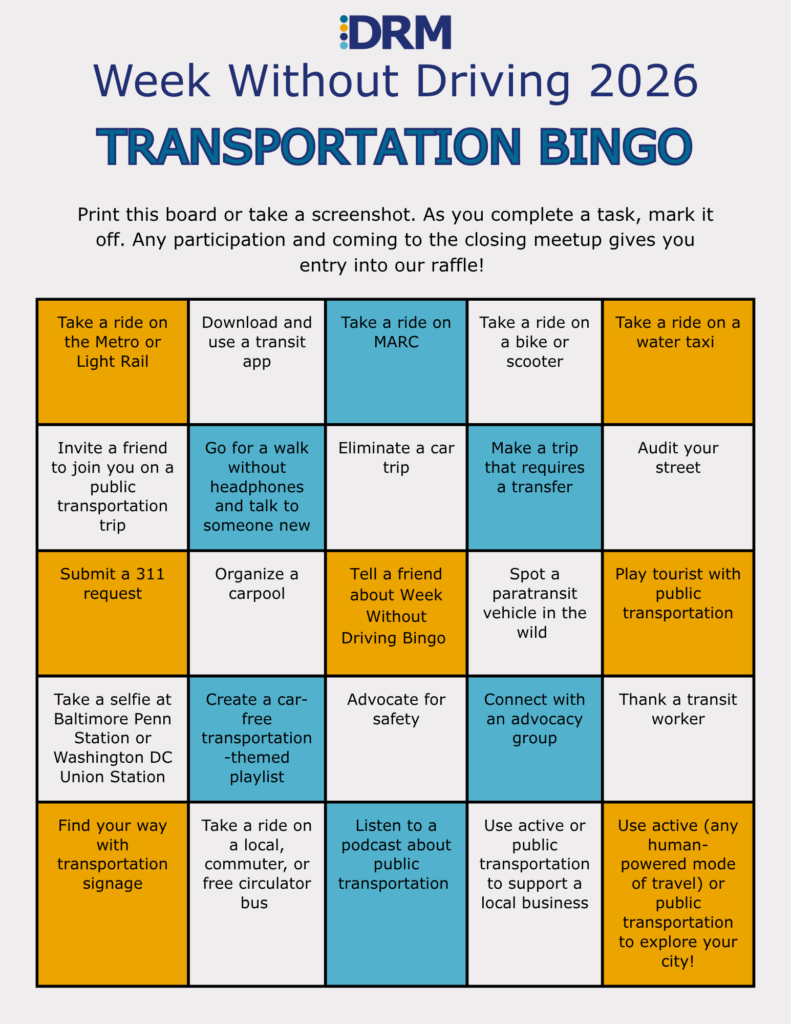
This year we are making Week Without Driving more fun with Transportation Bingo. The goal is not 5 in a row but doing something new and meaningful. Print this board or take a screenshot. As you complete a task, mark it off.
Anybody can play! Here’s how:
Rules
The bingo board has 25 squares. Each square contains a task. Complete a task to mark off that square on your board. You may try to earn as many (or as few) squares as you would like during the course of the week. Players who show us their completed bingo board at our gathering on Thursday, October 8, will be entered into a drawing for a chance to win a prize (must be present to win).
You do not have to refrain from driving for the entire week to play! Rather, use the game as an opportunity to reflect on (and change) your transportation habits, consider the needs and challenges that non-drivers face when moving around the city, and of course to be creative and have fun!
You may complete more than one square per trip, but if the board feels easy to you, then you can limit yourself to one square per trip. By participating, you are not entering into direct competition with other players. However, we do encourage you to invite others to play and to compete for fun against family members, coworkers, or friends!
All players are encouraged to share how they complete their squares on social media. Please share your adventures with us by using #WeekWithoutDriving and @DisabilityRightsMD on Facebook and Instagram or any other social media platforms you use.
We would like to thank the creators of TranspoBINGO for the inspiration and support! And our Transportation 101 partner, Roric McCorristin for being an organizer.
Closing Meet Up and Prizes
October 8, 2026
5pm-7:30pm
Main St. Market
The Lot @ 4500 Harford Rd
Any bingo participation and coming to the closing meetup gives you entry into our raffle!
Bingo Squares Explained
Tell a friend about Week Without Driving Bingo: Help us spread the word! Let a friend know about this game, or invite somebody to play with you (or against you!) and claim the center square!
Try out different modes of public transportation: Whether you are a first-time or an experienced rider, use public transportation this week and share impressions from your journey(s). Each mode below is its own square on the board.
- Take a ride on the Metro or Light Rail
- Take a ride on a local, commuter, or free circulator bus
- Take a ride on MARC
- Take a ride on a bike or scooter
- Take a ride on a water taxi
Invite a friend to join you on a public transportation trip
Go for a walk without headphones and talk to someone new
Eliminate a car trip: Plan ahead to ditch your car and get to someplace you need to be by using active (any human-powered mode of travel) or public transportation instead. Do you usually drive to a store that you could walk to instead? Got tickets to the game and don’t want to drive? Just tired of driving to work or class or anywhere else? Shake up your routine by taking public transportation instead of your car to earn this square!
Make a trip that requires a transfer: Take a trip that requires a transfer between two or more modes (bus to Light Rail, Metro to bus, etc.) or a transfer between two or more bus lines. Share how convenient or inconvenient the transfer is for you to make. How could it be improved or made more accessible?
Find your way with transportation signage: When you are out and about, pay close attention to the signage along your route. Is it visible and accessible to all? Look for outdated, faded or incorrect signage, and report it to the transportation agency or via a 311 request.
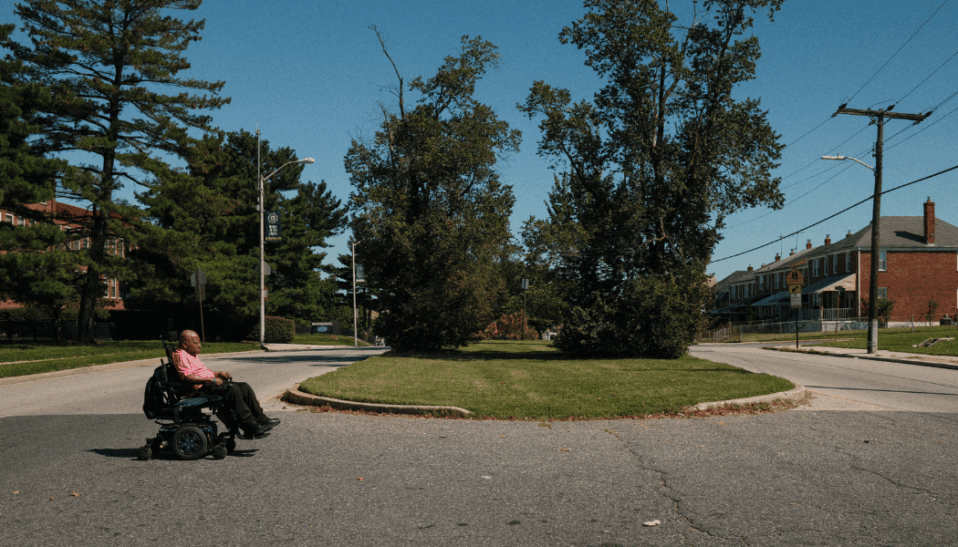
Audit your street: Look closely at the sidewalk, curbs, and street. How do you think it would go for somebody using a wheelchair, rollator, other assisted mobility device, or stroller? What about a neighbor who is blind or low vision? Are there detectable warning services on curb cuts, or audible cross signals? Document and share your observations to earn this square! See the AARP audit worksheet for an example.
Submit a 311 request: Call 311 or use the app to submit a city service request that would make neighborhood streets safer and more accessible. For example, request a needed footway/sidewalk repair (where one is broken, cracked, or chipped, creating a trip hazard); a new crosswalk at an intersection where one is needed; fresh striping for a faded crosswalk or bike lane; traffic calming measures on a street where speeding is a concern; or report an issue with a problematic public streetlight or traffic sign.
Organize a carpool: Coordinate with people you know to organize a carpool that would otherwise be multiple trips in single occupancy vehicles. Reducing the number of cars on the road makes our neighborhoods safer for everybody.
Advocate for safety: Write to a lawmaker about a transportation, accessibility, or street safety issue in your neighborhood.
Thank a transit worker: This week and always! Thank the workers who keep Baltimore’s streets, transit systems, and public spaces running. Simply say “Thank you!” to a bus or Metro operator, a school crossing guard, a trash and recycling collector, or another everyday hero. Or be more creative and visible about it – a wave, a note, a sign, or a shoutout on social media all count too!
Use active (any human-powered mode of travel) or public transportation to explore your city!
Do one of the following to earn this square:
- Visit a new-to-you public space: Use active or public transportation to visit a park, playground, library, or recreation center that you have never been to before. Is the space accessible for all to enjoy? What do you like about it and what do you feel could be improved? Share where you visited and how you got there!
- Explore a new-to-you neighborhood: Without using a car, visit a neighborhood that you would like to get to know better. Is there a place you usually drive through, but would like to see by foot or bike?
- Play tourist with public transportation: Leave your car at home and do something unabashedly touristy in your town! How many other tourists do you see using transit? Document and share your experience!
Take a selfie at Baltimore Penn Station or Washington DC Union Station: Get there without a car and take some time to explore. If you use the station regularly, slow down and find something interesting that you have never noticed before — or investigate something that you see every time. Take a selfie to show you were there and share pictures of what you discover!
Create a car-free transportation-themed playlist: To reflect on how entrenched car culture is in popular culture, create a playlist of songs about or referencing transportation… but not cars! Share your playlist with us to earn this square and so that we can create the ultimate playlist!
Connect with an advocacy group: There are many advocacy groups in Baltimore working to make the city’s transportation infrastructure safe and accessible for all residents. To earn this square, learn about their work and sign up for at least one group’s newsletter:
Download and use a transit app: There are many tools available to riders to help them navigate public transportation. CharmPass, Transit, Mobility All Access, and See Say are some examples. Riders can use apps to plan travel, pay for tickets, track the location and status of transit vehicles, and report issues. Use an app during your bingo adventures and share about your experience to earn this square!
Use active (any human-powered mode of travel) or public transportation to support a local business: Ditch your car and use active or public transportation instead to travel to a favorite local business or one you have been meaning to try out! Grab something to eat or drink, do some shopping, or treat yourself – you deserve it! Think about it as spending the money you can save by not driving on yourself and your community instead. 🙂
Spot a paratransit vehicle in the wild: Paratransit services are for people who, because of a disability, are unable to use the fixed route services offered in public transportation. Learn about paratransit services such as MobilityLink and Metro Access. Then share a picture of a paratransit vehicle that you see in public to earn this square! Did you know that individuals must register as certified riders to use paratransit? So consider sharing what you learn about paratransit with people you know who might qualify.
Submit feedback to a transit agency: Public transportation systems rely on feedback from their riders and customers to improve services and make them more accessible to all. Submit feedback about your experiences with public transportation to MTA, WMATA, or another transportation agency to earn this square!